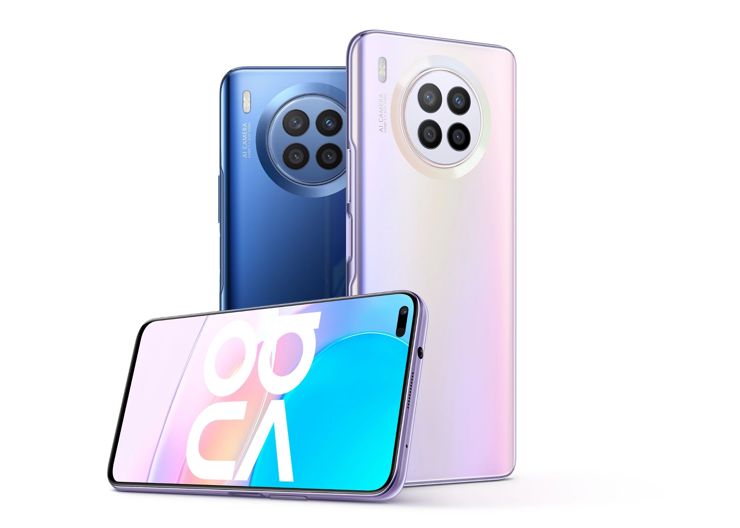
Huawei Nova 9 and Huawei Nova 9 Pro have already been officially presented by the manufacturer.
We have already got to know both models due to extensive leaks, but now we can verify the information about them and decorate them with official photos.
Huawei Nova 9
Huawei Nova 9 received a 6.57-inch OLED screen with rounded edges, Full HD+ resolution (2340 x 1080) and image refresh rate up to 120 Hz. The heart of the smartphone was the Snapdragon 778G processor, but unfortunately with a modem that only supports LTE networks. The lack of 5G is of course the result of US sanctions, not the producer's savings. The processor is supported by 8 GB of RAM and 128 or 256 GB of internal memory. The power supply is provided by a battery with an unimpressive capacity of 4300 mAh, but with a fairly impressive charging power - 66 W. In the photographic part we can find a 32-megapixel selfie camera with f/2.0 lens and a quad rear camera, the main matrix of which has 50 megapixels and works with lens with f/1.9 aperture. As support, we have two 2-megapixel cameras for macro and background blurring and an 8-megapixel wide-angle camera with f/2.2 aperture. There are four colour versions and two flash drives to choose from, and prices are 2699 and 2999 yuan. After converting, they will be $ 419-465.


photo: Huawei
Huawei Nova 9 Pro
Huawei Nova 9 Pro also has an OLED screen with a refresh rate of 120 Hz, but a bit larger, 6.72-inch with a slightly different resolution - 2676 x 1236 px. The processor and memory are the same as on the Huawei Nova 9 Pro, as is the rear camera. The front camera is double for it - another 32-megapixel matrix has been added to it, but with an f/2.4 wide-angle lens. The battery has shrunk to 4000 mAh, but it charges even faster than in the base model, with a power of 100 W. Again, we have a choice of four color versions and two prices, depending on the internal memory - 128 or 256 GB. They are respectively 3,499 and 3,899 yuan, or $ 542-604. Both models, "thanks" to US sanctions, work on the Harmony OS platform, without Google's "blessing".


photo: Huawei
Huawei Nova 9 go to specification →


-
 6.57" OLED
1080 x 2340 px
6.57" OLED
1080 x 2340 px
Aspect ratio: 19.5:9 -
 160.00 x 73.70 x 7.77 mm
175.00 g
160.00 x 73.70 x 7.77 mm
175.00 g
-
 50 Mpx
Front: 32 Mpx
50 Mpx
Front: 32 Mpx
-
 Li-Ion 4300 mAh
Quick battery charging
Li-Ion 4300 mAh
Quick battery charging
-
 8 GB
8 GB
-
 128 GB, 256 GB
-
 Qualcomm Snapdragon 778G SM7325
-
 3Q 2021
-
 553.41 C2T
Battery capacity to thickness ratio
553.41 C2T
Battery capacity to thickness ratio
-
 89.90%
Screen-to-body ratio
89.90%
Screen-to-body ratio
Huawei Nova 9 Pro go to specification →


-
6.72" OLED
1236 x 2676 px
Aspect ratio: 19.5:9 -
163.40 x 74.40 x 7.97 mm
186.00 g
-
50 Mpx
Front: 32 Mpx
-
Li-Ion 4000 mAh
Quick battery charging
-
8 GB
-
128 GB, 256 GB
-
Qualcomm Snapdragon 778G SM7325
-
3Q 2021
-
501.88 C2T
Battery capacity to thickness ratio
-
91.20%
Screen-to-body ratio